
What Everyone Missed About Justin Gaethje Before UFC Freedom 250
Justin Gaethje pulled off the impossible at UFC Freedom 250 — and the signs were there in the metrics all along.
Jun 19, 2026

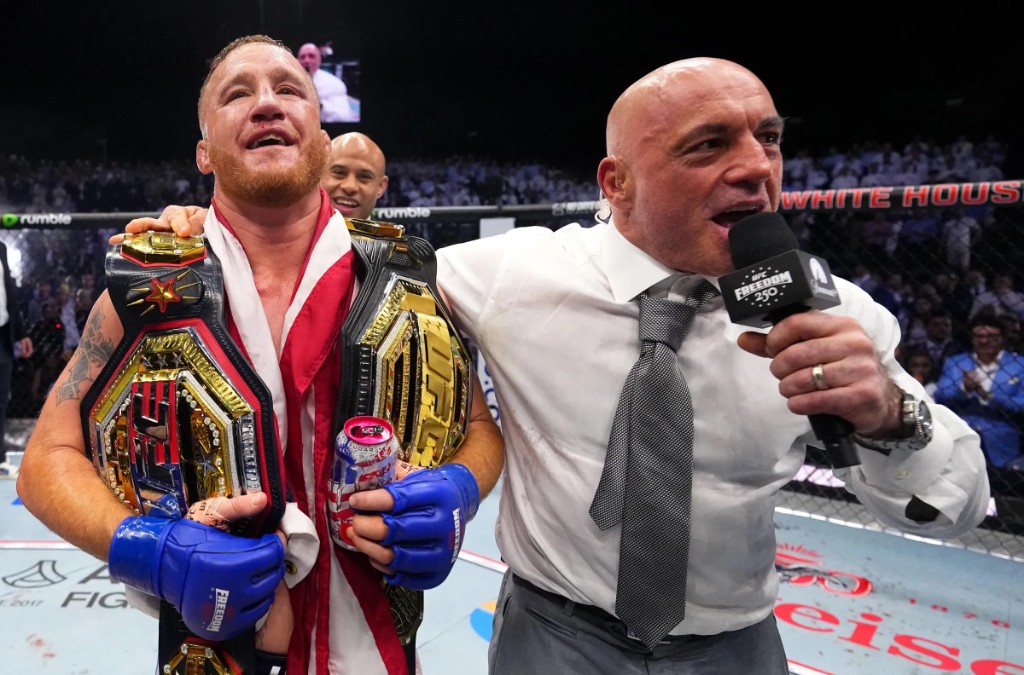
Wow. To start, I don't even know what's more shocking: that we just witnessed a UFC event on the White House lawn, or that Justin Gaethje just made Ilia Topuria quit on the stool.
Look, to start, it was America's Day, UFC Freedom 250. There was no more perfect way to end it than with a Justin Gaethje upset victory. But there is more to break down than just that. Justin came in with very few advantages other than experience and, to be honest, grit. Statistically, Justin wasn't the obvious pick either. Despite carrying a negative striking success rate, which measures significant strikes landed per minute minus significant strikes absorbed per minute, he has consistently found ways to beat elite fighters through experience, awkward timing, elite clinch work, and a unique ability to turn his uppercut into a straight right that catches opponents as they try to exit exchanges. The man has taken punches—and quite a lot of them. On the flip side, Ilia has rarely been touched. So as advertised the two came out trading, chins in the air, both wanting to leave with the belt on this historic night.
A key takeaway was Justin pumping a nasty jab and straight right to Ilia's face in round 1 causing early damage to the champion's orbital bone and nose, a level of discomfort and disadvantage he has truly never faced before. It's also worth noting that this is exactly the kind of sequence our striking metrics have always loved from Justin. While he absorbs plenty of damage himself, his ability to create high-impact moments with simple combinations has consistently led to positive striking grades in our models. Justin didn't just hurt the champ early, he was able to win round 1.
Round two is where things took a turn. Ilia pushed the pace and crushed Justin's body. Justin nearly folded and looked like he was on his way out of the fight. Now, Ilia is an elite-tier grappler and submission specialist, but in a moment like this, I think Justin's experience being compromised in the most pressure-filled moments allowed him to navigate and survive. Ilia went to the mat with him looking for the finish, first with his hands and then with his submission skills. A failed Khabib Nurmagomedov-style triangle choke from mount and then a belly-down armbar left the champ not only discouraged but also a little gassed by the end of the second round.
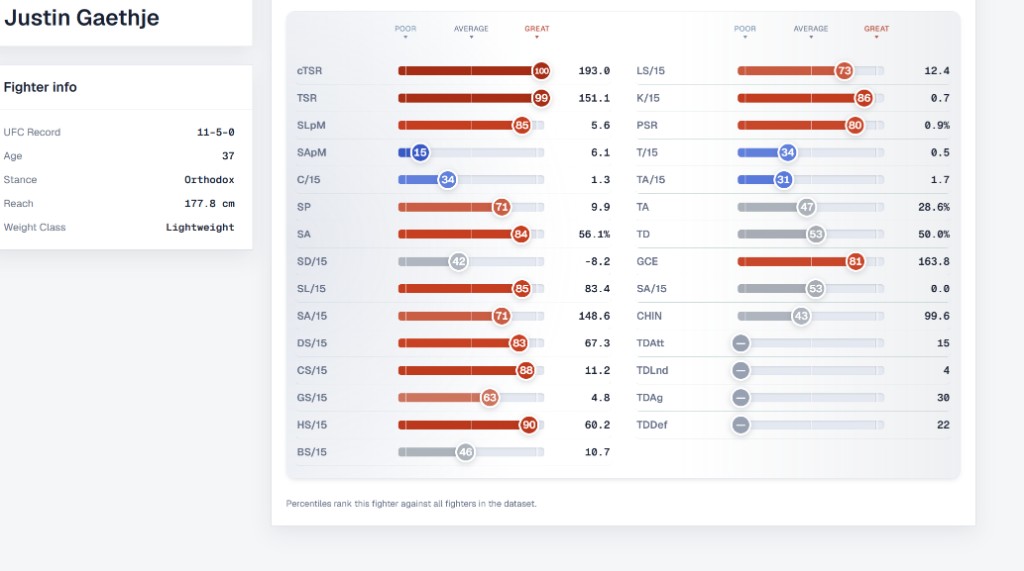
Now the third round began, and nobody expected it to go the way it did. Although Justin was almost finished in round two, he looked fresher and less damaged, while Ilia's face was busted up. The reason Justin has been so successful throughout his career was on full display in this round. He is a kill-or-be-killed fighter, and he was in full kill mode. He truly showed why our striking metrics have his UFC Savant page DARK red (see Figure 1). Justin has never been a clean, technical point fighter. His greatness comes from his ability to weaponize chaos. Even with a negative striking success rate throughout much of his career, he combines pressure, power, clinch work, and unconventional entries better than almost anyone in the sport. When opponents start slowing down, those traits become incredibly difficult to deal with. Ilia was pumping out weak straights, leaving his hands down and showing bad body language, creating clear openings for Justin to pump jabs and clean one-two combinations. Going back and re-watching the fight it's easy to tell Ilia was leaving himself exposed with lazy strikes leading to clear openings for Justin. All round long, Justin pummeled Ilia, beating his face to the point of near non-recognition.
At this point, both of Ilia's eyes were nearly shut, and clear orbital fractures were becoming a topic of conversation. We hear him say he can't see between rounds before the physician comes in and wants to stop the fight. But Ilia pleaded to continue, and we got round four. In the championship rounds, the odds had truly flipped. Justin was in the driver's seat. Both historically and metrically, he is the better fighter in these moments as his ability to absorb damage yet remain competitive in the octagon is, bar none, the statistics show it. Some fighters fall apart when fights become ugly. Justin thrives there. This willingness to absorb damage in order to create damaging exchanges of his own has been one of the defining traits of his career. Ilia's facial damage and minimal experience in later rounds left him as a sitting duck. Three more minutes of Justin keeping it simple and clobbering the champion's face over and over again followed before Ilia found some success on the ground. But it wasn't enough. Justin got back up, landed a few final shots, and the bell rang.
Ilia stumbled back to the stool, most likely seeing little more than darkness, as he sat down looking defeated and discouraged. His corner helped him get centered as his eyes were swollen shut, later finding out he had fractured both his orbitals and his nose. It would be kind to say, his face was destroyed, and the corner had seen enough. They threw in the towel.
And that's that. Justin pulls off the impossible and becomes the new and well-deserved champion. Justin showed, both metrically and physically, his full arsenal: get hit, but hit back more. And heart-wise, he showed he had that dog in him—that will to win. He came in, put all those heartbreaking losses behind him, and finished one of the greatest fighters of all time.
In no world did anyone think Justin Gaethje would walk away with the belt while Ilia Topuria was being helped by his brother and the rest of his corner back to the locker room, seeing nothing but darkness and a long recovery ahead. Justin's best attribute isn't being a great fighter. It's that he's a warrior. A truly one-of-a-kind champion.
What an event. What a magical ending.